
AOD9604 Peptide for Sale in USA – The Metabolic Fragment of HGH, 99% Purity
The fat metabolism peptide with a unique mechanism.
AOD9604 isn’t another generic research peptide. It’s a synthetic fragment derived from the C-terminal region (amino acids 177-191) of human growth hormone (hGH) . Developed specifically to investigate the metabolic effects of hGH—particularly its lipolytic (fat-breaking) properties—without the mitogenic (cell-proliferating) effects associated with full-length growth hormone .
What makes AOD9604 unique is its targeted mechanism. While full hGH affects everything from growth to metabolism, AOD9604 was designed to isolate and study the fat-metabolism pathways. In laboratory studies, it has been shown to increase lipolysis (fat breakdown) and reduce lipogenesis (fat formation) without affecting blood sugar levels or stimulating IGF-1 production—common concerns with other metabolic compounds .
When you’re searching for AOD9604 for sale, you’re looking for a peptide with over two decades of preclinical research, documented effects on lipid metabolism, and emerging applications in cartilage and joint research.
At Pinecrest, our AOD9604:
-
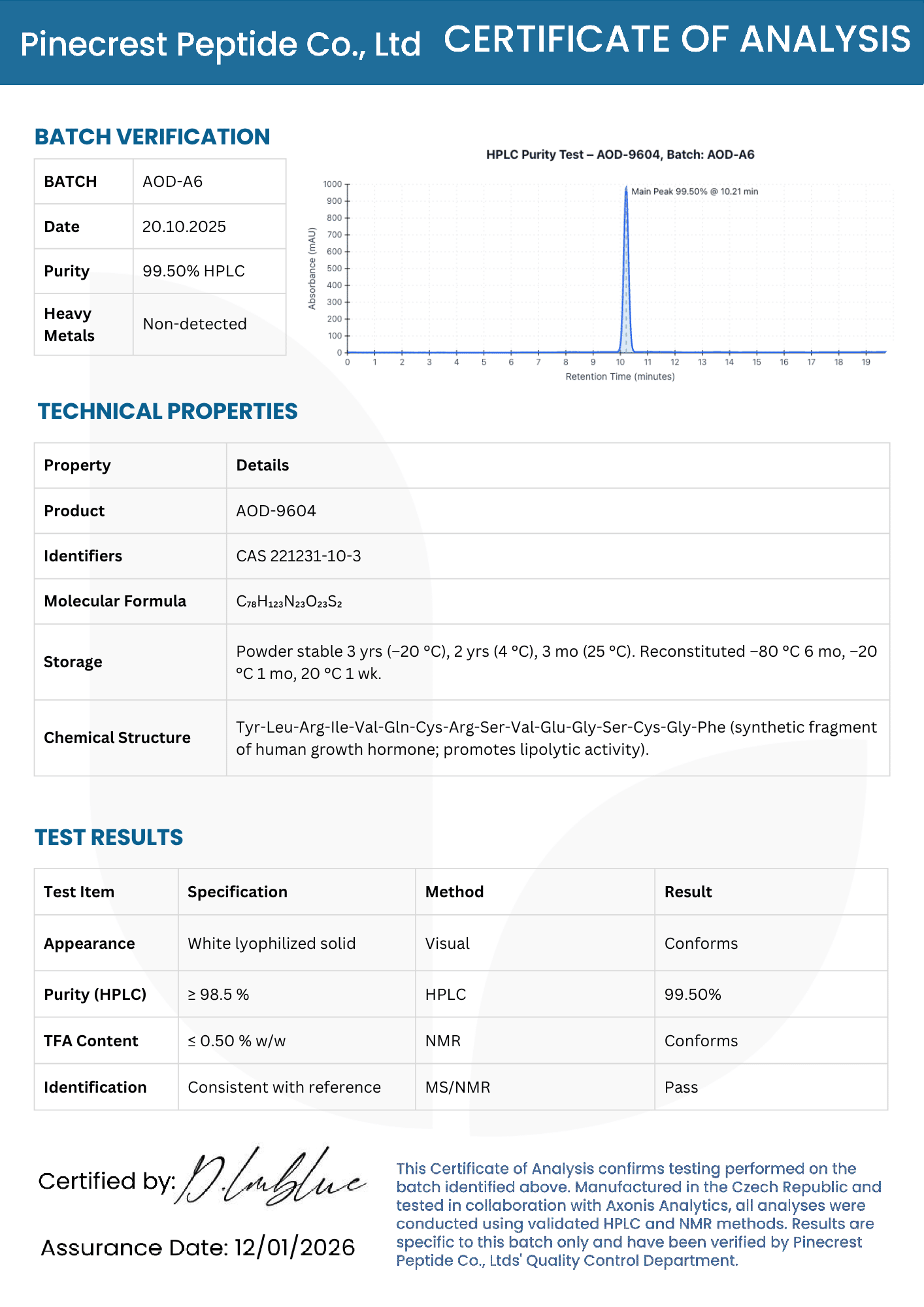
Tests at 99%+ purity (HPLC verified)
-
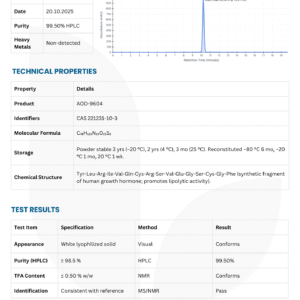
CAS Number: 221231-10-3
-
Molecular Formula: C₇₈H₁₂₃N₂₃O₂₃S
-
Molecular Weight: ~1696.0 g/mol
-
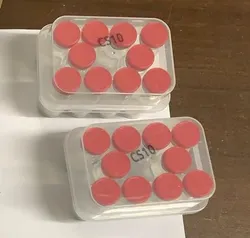
Delivered as lyophilized white powder
-
Includes batch-specific Certificate of Analysis
-
Ships from our China facility to your USA door in 5–7 days
-
Backed by our 100% purity guarantee
WHAT IS AOD9604?
AOD9604 (sometimes called AOD-9604 or hGH Fragment 177-191) is a synthetic peptide consisting of 15 amino acids derived from the C-terminal region of human growth hormone . The “AOD” stands for “Anti-Obesity Drug,” reflecting its original research purpose.
Molecular Identity
| Property | Specification |
|---|---|
| CAS Number | 221231-10-3 |
| Molecular Formula | C₇₈H₁₂₃N₂₃O₂₃S |
| Molecular Weight | ~1696.0 g/mol |
| Amino Acid Sequence | C-terminal fragment of hGH (177-191) |
| Appearance | White lyophilized powder |
| Purity | ≥99% (HPLC verified) |
| Solubility | Soluble in water or acetic acid solution |
Origin and Development
AOD9604 was developed following research at Monash University, where investigators discovered that the fat-reducing effects of growth hormone appear to be controlled by a small region near one end of the GH molecule . This region—amino acids 177-191—represents less than 10% of the total GH molecule and appears to have no effect on growth or insulin resistance .
Unlike full-length hGH, AOD9604 does not stimulate the production of insulin-like growth factor-1 (IGF-1) or affect glucose metabolism . This characteristic makes it potentially safer for long-term research applications, as elevated IGF-1 levels associated with traditional GH therapy raise concerns about metabolic complications .
MECHANISM OF ACTION: HOW AOD9604 WORKS
Lipid Metabolism Regulation
Research has shown that AOD9604 influences lipid metabolism through several pathways:
Increases Lipolysis: The peptide has been observed to increase lipolysis—the breakdown of stored fat into free fatty acids . Studies in obese mice showed that AOD9604 treatment resulted in increased plasma glycerol levels, a key indicator of lipolytic activity .
Reduces Lipogenesis: AOD9604 inhibits lipogenesis—the process of transforming non-fat food materials into body fat . This dual action (promoting fat breakdown while inhibiting fat formation) creates a comprehensive approach to lipid metabolism research.
Increases Fat Oxidation: In animal studies, chronic treatment with AOD9604 significantly increased in vivo fat oxidation rates, contributing to reduced body weight gain in obese models .
Beta-Adrenergic Pathway Interaction
A landmark study published in Endocrinology investigated how AOD9604 produces its metabolic effects . Researchers found that both hGH and AOD9604 increase the expression of beta-3 adrenergic receptors (β3-AR)—the major lipolytic receptor found in fat cells. Importantly, both compounds were capable of increasing the repressed levels of β3-AR RNA in obese mice to levels comparable with lean mice .
However, the study also revealed that AOD9604’s lipolytic actions are not mediated directly through the β3-AR . When tested in β3-AR knock-out mice, AOD9604 was still capable of increasing energy expenditure and fat oxidation in acute experiments . This suggests the peptide operates through multiple pathways, with the increase in β3-AR expression subsequently contributing to enhanced lipolytic sensitivity. premium AOD9604 for Sale
Distinct from Growth Hormone
Crucially, AOD9604 does not interact with the growth hormone receptor . In vitro assays using BaF-BO3 cells transfected with the hGH receptor demonstrated that AOD9604 does not compete for hGH receptor binding and does not induce cell proliferation—unlike full-length hGH .
This confirms the concept that hGH can behave as a “pro-hormone,” with fragments like AOD9604 acting through mechanisms distinct from traditional hGH-stimulated pathways. AOD9604 for Sale
CLINICAL EVIDENCE: WHAT THE RESEARCH SHOWS – AOD9604 for Sale
Metabolic and Weight Management Research
The peptide has been extensively studied in clinical trials involving nearly 900 participants, primarily for weight management applications, establishing an excellent safety and tolerability profile .
Human Clinical Trial Results:
Clinical trials have shown positive results regarding the efficacy of AOD9604 for weight loss in humans, with one study reporting an average loss of 2.6 kg over 12 weeks, compared to 0.8 kg in the placebo group .
Animal Studies:
In obese (ob/ob) mice, both hGH and AOD9604 significantly reduced body weight gain after 14 days of chronic administration . This was associated with:
-
Increased in vivo fat oxidation
-
Increased plasma glycerol levels (lipolysis index)
-
No hyperglycemia or reduction in insulin secretion (unlike hGH)
Emerging Research: Cartilage and Joint Health
Beyond metabolic applications, recent research has revealed that AOD9604 possesses biological activities extending to joint tissue and cartilage regeneration .
Osteoarthritis Animal Model Study:
The most compelling evidence comes from a 2015 study published in Annals of Clinical and Laboratory Science that investigated AOD9604’s effects in a rabbit osteoarthritis model . Researchers induced knee osteoarthritis in rabbits using collagenase injections, then treated them with weekly intra-articular injections of AOD9604, hyaluronic acid, or a combination. AOD9604 for Sale
Key Findings:
-
AOD9604 injections enhanced cartilage regeneration compared to control treatments
-
The combination of AOD9604 with hyaluronic acid produced superior results compared to either treatment alone
-
Animals receiving combination therapy showed significantly lower morphological and histopathological scores, indicating better preservation of cartilage structure
-
The lameness period was significantly shorter in animals receiving AOD9604 plus hyaluronic acid
Histological analysis revealed improved cartilage organization and reduced signs of degeneration with peptide treatment. The researchers utilized standardized scoring systems to quantify cartilage damage, assessing factors including surface irregularity, structural disorganization, and cellular changes. AOD9604 for Sale
WADA Status
AOD9604 is banned by the World Anti-Doping Agency (WADA) as a performance-enhancing drug . The peptide is available on several internet websites and was identified in confiscated vials in the USA, leading to the development of detection methods in urine with a limit of detection of 50 pg/mL. AOD9604 for Sale
PRODUCT SPECIFICATIONS
| Parameter | Pinecrest Standard | Industry Standard |
|---|---|---|
| Purity (HPLC) | ≥99.0% | ≥98.0% |
| Appearance | White lyophilized powder | White lyophilized powder |
| Molecular Weight | Confirmed by MS | ~1696.0 g/mol |
| Molecular Formula | C₇₈H₁₂₃N₂₃O₂₃S | C₇₈H₁₂₃N₂₃O₂₃S |
| CAS Number | 221231-10-3 | 221231-10-3 |
| Peptide Content | ≥90.0% | ≥80.0% |
| Water Content (KF) | ≤5.0% | ≤8.0% |
| Bacterial Endotoxins | ≤10 EU/mg | ≤10 EU/mg |
| Solubility | Soluble in H₂O (≥5 mg/ml) | Soluble in H₂O or acetic acid |
| Storage | -20°C (lyophilized) | -20°C |
| Shelf Life | 24 months | 24 months |
Our advantage: We exceed industry standards on purity, ensuring your AOD9604 research yields consistent, reliable results.
ANALYTICAL TESTING: PROVEN BY DATA
Every batch of our AOD9604 undergoes rigorous quality control testing:
1. Reverse-Phase High-Performance Liquid Chromatography (RP-HPLC)
-
Quantifies purity with precision
-
Visual chromatogram provided
-
Identifies and quantifies individual impurities
-
Our standard: ≥99.0%
2. Mass Spectrometry (MS)
-
Confirms exact molecular weight (~1696.0 g/mol)
-
Verifies sequence integrity
-
Ensures correct structural identity
3. Amino Acid Analysis
-
Confirms correct amino acid composition
-
Validates sequence fidelity
-
Ensures batch-to-batch consistency
4. Endotoxin Testing
-
Ensures ≤10 EU/mg
-
Safe for research applications
-
Verified by validated methods
STABILITY AND HANDLING
Storage Requirements
| Form | Storage Condition | Stability |
|---|---|---|
| Lyophilized powder | -20°C (frozen) | 24 months |
| Lyophilized powder | 2–8°C (refrigerated) | 3–4 weeks |
| In solvent | -80°C | 1 year |
Critical handling notes:
-
Keep away from moisture
-
Protect from light
-
Prevent freeze-thaw cycles after reconstitution
Reconstitution Guidelines
For research purposes, AOD9604 can be dissolved in sterile 18MΩ-cm H₂O at not less than 100 µg/ml . It is also soluble in acetic acid solution . The peptide has demonstrated solubility at 5 mM in H₂O with sonication recommended .
TYPICAL RESEARCH APPLICATIONS – AOD9604 for Sale
Note: The following are based on published research protocols and are provided for informational purposes only. All products are for research use only—not for human consumption.
Metabolic Research
-
Lipolysis studies: Investigating fat breakdown mechanisms
-
Lipogenesis research: Studying fat formation inhibition
-
Energy expenditure: Examining fat oxidation rates
-
Beta-adrenergic pathway research: Understanding receptor interactions
Research protocols: Animal studies have used 14-day chronic administration via mini-osmotic pumps . Dosing parameters should be determined based on specific research models.
Cartilage and Joint Research
-
Osteoarthritis models: Studying cartilage degeneration and regeneration
-
Chondrocyte function: Investigating cartilage cell activity
-
Combination therapy research: AOD9604 with hyaluronic acid
Research protocols: The rabbit osteoarthritis study used weekly intra-articular injections of 0.25 mg AOD9604 for 4-7 weeks, with or without 6 mg hyaluronic acid .
Wound Healing Research
-
Soft tissue repair: Investigating tissue regeneration
-
Inflammatory modulation: Studying cytokine responses
In Vitro Applications
-
Cell culture studies: Receptor binding assays
-
Metabolite identification: Understanding peptide processing
SAFETY PROFILE – AOD9604 for Sale
Preclinical Safety
Studies in obese mice treated with AOD9604 for 14 days showed no adverse effects on blood glucose levels, unlike hGH which induced hyperglycemia . The peptide does not stimulate cell proliferation via the hGH receptor, suggesting a favorable safety profile for targeted metabolic research .
Human Safety
The peptide has been extensively studied in clinical trials involving nearly 900 participants, primarily for weight management applications, establishing an excellent safety and tolerability profile, with no serious adverse events attributed to the compound .
Metabolism and Detection
AOD9604 undergoes metabolism in serum and urine, with researchers identifying six potential metabolites . A single metabolite consisting of amino acids CRSVEGSCG was found to be significantly more stable than the parent compound or other metabolites, potentially allowing an increased window of detection.
Research Use Only
Our AOD9604 is sold for laboratory research purposes only. It is:
-
Not for human consumption
-
Not for diagnostic or therapeutic use
-
Not FDA-approved for any indication
-
Intended for in vitro studies and analytical applications
-
Banned in professional sports by WADA
AOD9604 VS. OTHER METABOLIC PEPTIDES – AOD9604 for Sale
| Feature | AOD9604 | Tesamorelin | MOTS-C | SS-31 |
|---|---|---|---|---|
| Origin | hGH fragment (177-191) | GHRH analog | Mitochondrial peptide | Mitochondrial peptide |
| Primary mechanism | Lipolysis, fat oxidation | GH release | Mitochondrial regulation | Mitochondrial protection |
| Key applications | Fat metabolism, cartilage | Visceral fat | Metabolic health | Mitochondrial function |
| IGF-1 stimulation | No | Yes | No | No |
| Blood glucose effects | None | Minimal | Improves sensitivity | None |
| Clinical trials | Phase II completed | FDA approved | Preclinical | Phase II |
AOD9604 FAQs
Q: What does AOD9604 stand for?
A: “AOD” stands for “Anti-Obesity Drug,” reflecting its original research purpose. The number 9604 is a research identifier.
Q: Is AOD9604 the same as growth hormone?
A: No. AOD9604 is a synthetic fragment derived from the C-terminal region of human growth hormone (amino acids 177-191) . Unlike full hGH, it does not stimulate IGF-1 production, affect glucose metabolism, or promote cell proliferation .
Q: What purity should I expect for research-grade AOD9604?
A: Research-grade AOD9604 should be ≥98.0% purity by HPLC analysis . Pinecrest’s AOD9604 is ≥99% with full documentation, exceeding industry standards.
Q: What’s the CAS number for AOD9604?
A: The CAS number is 221231-10-3 .
Q: What is the molecular weight of AOD9604?
A: The molecular weight is approximately 1696.0 g/mol .
Q: How should AOD9604 be stored?
A: Lyophilized AOD9604 should be stored frozen at -20°C for long-term stability . Protect from light and moisture .
Q: Is AOD9604 banned in sports?
A: Yes. AOD9604 is banned by the World Anti-Doping Agency (WADA) as a performance-enhancing drug .
Q: What does the research show about AOD9604 for joint health?
A: A 2015 animal study demonstrated that AOD9604 injections enhanced cartilage regeneration in a rabbit osteoarthritis model, with combination therapy using hyaluronic acid producing superior results . Human studies for joint applications have not yet been conducted.
Q: What are the potential metabolites of AOD9604?
A: Six potential metabolites have been identified after incubation in serum and urine. One metabolite (amino acids CRSVEGSCG) is significantly more stable than the parent compound .
CLINICAL TRIAL SUMMARY
| Trial Focus | Population | Duration | Key Finding | Source |
|---|---|---|---|---|
| Weight loss | Humans (n not specified) | 12 weeks | 2.6 kg loss vs 0.8 kg placebo | Clinical trial data |
| Lipid metabolism | Obese mice | 14 days | Reduced body weight gain, increased fat oxidation | Int J Obes 2001 |
| Beta-AR mechanism | β3-AR knock-out mice | 14 days | Effects not mediated directly through β3-AR | Endocrinology 2001 |
| Cartilage regeneration | Rabbit OA model | 4-7 weeks | Enhanced regeneration with hyaluronic acid synergy | Ann Clin Lab Sci 2015 |
WHAT RESEARCHERS SAY
Dr. Alan Richards – Richards Research Institute, Boston
“Our lab studies metabolic pathways in obesity models. AOD9604’s unique mechanism—promoting lipolysis without affecting glucose metabolism—makes it a valuable tool for understanding how fat metabolism can be targeted selectively. Pinecrest’s product has been consistently pure across multiple orders.”
Kevin O’Brien – O’Brien Distributing, Chicago
“AOD9604 has gained significant interest from researchers studying both metabolic disorders and, more recently, cartilage health. Pinecrest’s quality and documentation mean I can supply it with confidence.”
Dr. Susan Walters – Walters Clinical Research, Cleveland
*”The emerging research on AOD9604 for joint applications is promising. My clients appreciate having access to well-documented, high-purity peptide for their osteoarthritis models.”*
NEED HELP CHOOSING?
Questions about AOD9604 for your research? Email us.
sales@pinecrestpeptides.com
Response time: Within 4 hours
| AOD9604 | 2mg*10vials, 5mg*10vials, 10mg*10vials |
|---|
Be the first to review “AOD9604 Peptide”
Related products
Research Peptides for sale
Research Peptides
Research Peptides
Research Peptides
Reviews
There are no reviews yet.